Ready or Not, You Have Been Promoted!
Your team lead sucks
You are a developer, and your team lead sucks at their job. They are busy meeting with so-called “stakeholders” instead of meeting with the team and helping you. They schedule all these pointless 1:1s. As a result, they have no time for hands-on coding, so they forget the true way of software engineering.
If only you were a team lead, you would do way better. You would always code yourself and conduct thorough, diligent code reviews for others. You would communicate better, and never will a developer need to rework everything from scratch just because the team lead couldn’t explain the task well. And this “management” work that apparently gives a huge overhead to any of their work? Yeah, you definitely would do it in 2 minutes.
Rejoice, for the time has come to prove yourself! Because of AI agents,
AI is here to stay
AI tools for software development are here, and they are here to stay. Google’s DORA Report shows that 90% of software engineers use AI at work, increasing from 75% of software engineers using AI tools in 2024. To paraphrase: if you haven’t used any AI tools for at least a year, you are a minority.
And that’s ok. Picture that: we could be writing code in vim - and some people do. But most of us prefer to use specialized IDEs that have autocomplete, refactoring, and code analysis capabilities. Just because with IDEs we can do more and better work in less time, while spending fewer hours on tedious and annoying debugging of typos.
The same is happening with AI tools in software development. AI tools are already very capable, and they will only get better every year and every month. Today, you already need to use AI tools to do your job, alongside an IDE - and in the same manner as an IDE. Doing the work without tools is too slow, error-prone, or tedious.
AI is a middle-level developer
There is a difference between AI-infused autocomplete and standalone AI agents fully capable of implementing a feature from a Jira ticket. Maybe you only use AI minorly, to speed up typing standard statements, but you don’t trust it to write any large pieces yet.
The market thinks otherwise. The most influential benchmark for AI agents is SWE‑bench Verified that uses real-world GitHub issues. It shows that in the last two years, we went from “AI, which AI?” to agents that we can give real-world issues, and they will solve 75% of them using an abundance of different tools, provided you prompt them correctly.
It stands to reason that the “90% of software engineers using AI” from above will eventually (if not yet) delegate the tasks to the agents and only supervise them. The agents are certainly imperfect, but they are good enough. In comparison, have you ever seen a human employed at a well-paying job, who:
- does coding,
- takes a supply of tasks and working tools,
- solves 75% of these tasks - in the repo they see for the first time, mind you,
- still needs supervision and code review because you never know when the “25%” will come and they fail,
- performs differently based on the way you formulated your questions,
- and the “correct” way of communicating is tricky?
You must’ve, because
AI agent supervisors are team leads
Does this mean that AI-agent-supervising developers are like developer-supervising team leads? I would like to argue that yes, they are. A modern-day team lead may wear one of the five hats, depending on the company, which are: administrator, integrator, people manager, product owner, and technical leader1:
| Responsibility | Team lead | AI agents supervisor |
|---|---|---|
| Administrator | Plans and decomposes tasks for developers, collects and aligns results | Plans and decomposes tasks for agents, collects and aligns results |
| Integrator | Knows company-specific culture, practices, and business to make team efficient | Knows company-specific culture, practices, and business to make the AI team efficient |
| People Management | Hires team, teaches and coaches people with materials, handles team communication, and balances their strengths | Buys AI tools, “teaches” AI with documentation, handles AI agents’ behaviour with prompts, and balances the strengths of different models |
| Product Ownership | Understands the product and the market, and makes product decisions | Understands the product and the market, and makes product decisions |
| Technical Leadership | Establishes CI and QA processes to assure technical quality, and makes architectural decisions | Establishes CI and QA processes to assure technical quality, and makes architectural decisions |
Team lead delegates tasks to other actors, learns how to interact with them, provides them with resources, assistance, and broader knowledge, and reviews their work critically and regularly. This is exactly what a supervisor of AI agents does! With the roles being the same, the AI supervisor is effectively a team lead.
So, are you a developer? Congratulations, during the last year you have been (involuntarily) promoted to a team lead!
Conclusion
Many innovative areas underwent this transition. It was great to be a scientist (I imagine) in the 1950s-60s. You could satisfy your curiosity at the government’s expense, dig deep into any topic you wanted, and the cool computational tools were becoming available to you. You alone were enough to deliver enormously cool results.
Today, if you are a scientist, then you must aspire to run a group, you must do lots of project management, also train and lead PhD students and employees, while maintaining the general vision for your projects. You only can’t do hands-on research yourself. There are still individual geniuses, but a randomly chosen scientist is nowadays much more likely to be a team lead of junior researchers, rather than a senior scientist.
Software engineering used to be “a single senior person getting the job done”. There are many famous geniuses that any software engineer has heard of. And only a very limited number of people needed to be team leads in that era, for everyone can’t be a manager. AI is changing this.
Welcome to the Team Leads Club. We have: tired (ran out of tokens) and burned-out (catastrophic forgetting) AI models, disagreements between your AI subordinates, and a need to juggle projects bigger than you can comprehend. No, there will be no budget for a raise.
Erratum (sort of)
While writing this piece, I had to correct myself a few times. I thought it would be insightful to share how my attitudes changed over time:
Present, not future
The original draft was written in the future tense when referring to the use of AI tools. I presumed AI proponents to be my bubble, and AI skeptics to be a majority, as the latter is a common attitude in the media. So I wrote “You will need to use AI agents”, etc. I changed the phrasing to the present tense during editing, when I realized what “90% of developers are already using AI tools” actually means.
Middle, not junior
I also referred to a team of AI agents at first as “highly motivated and vaguely competent junior developers”. It is keen to please me, but not very good at doing the actual job, so it must be a junior, right? Then I thought about “75%+ of GitHub issues resolved” deeper. And came to the conclusion you see in the text - it is middle’s level, not junior’s. Feel free to argue on my LinkedIn.
Underestimating or overestimating?
When I started writing this post, I thought this idea was very brave. No developers in 2 years, only team leads. Now I wonder whether I am underestimating the speed of change. Projecting this rate of growth is tricky:
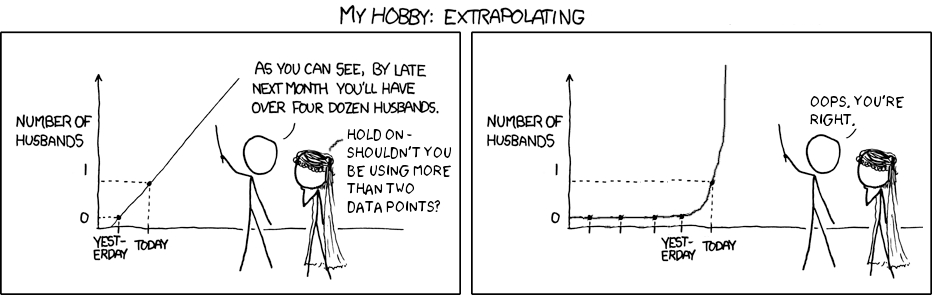
But it sounds plausible that at the current rate of growth, we will get fully-functional senior- or even team lead-level AI agents in a year or two. Who are we going to become then? VPs of Engineering? PMs? Customer Success?
According to the roadmap of team lead skills created by Stas Tsyganov, Egor Tolstoy & Community. Material is available under CC-BY-SA-4.0 license, but, unfortunately, only in the Russian language - use automatic translation. ↩︎
